
Broadcasting is the process of distributing television, radio and other media content from a source to an audience through terrestrial transmitters, satellites, cable networks, IP networks or a combination of delivery platforms. Modern broadcast technology extends far beyond the traditional concept of transmitting a television or radio signal. Today’s broadcasting environments can combine content production, playout, encoding, multiplexing, transmission, satellite distribution, Digital Terrestrial Television (DTT), Direct-to-Home (DTH), IPTV and OTT services within an integrated media ecosystem.
For broadcasters, governments, telecommunications providers and media organisations, the technology selected for broadcasting influences coverage, capacity, picture quality, operational resilience and how audiences access content. Across Africa, these decisions can be particularly important because networks may need to serve dense cities, rural communities and remote regions while accounting for available spectrum, connectivity, power infrastructure and existing broadcast systems. Understanding how the complete broadcasting chain works helps organisations select technology that matches their coverage, service and operational requirements.
What Is Broadcasting?
Broadcasting is the distribution of audio, video or other media content to an audience using an electronic communications network. Traditional television broadcasting generally uses a one-to-many model: a broadcaster prepares a service and transmits it so that many viewers within the coverage area can receive the same content. Radio operates on a similar principle, although the underlying frequencies, equipment and service formats differ.
Digital technology has expanded this definition considerably. A modern broadcaster may distribute the same television channels through terrestrial transmitters, satellite services and internet-based platforms. The underlying broadcast technology therefore needs to manage content from the point of production through processing and distribution to the receiving platform used by the audience.
The International Telecommunication Union (ITU) describes digital television broadcasting in terms of interconnected networks and systems covering areas such as programme production, distribution, transmission quality, multimedia broadcasting and service implementation. Modern broadcasting should therefore be considered as a complete technical chain rather than simply the transmitter that sends the final signal to viewers.
How Does Modern Broadcasting Work?
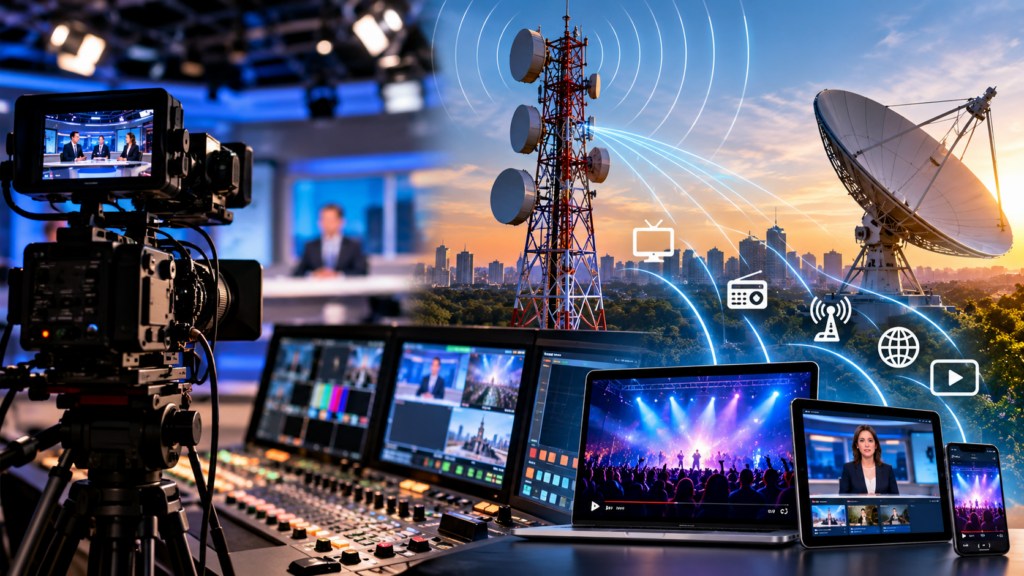
A broadcasting system begins with content. Television programmes, live events, news, advertising and other media may originate from studios, production facilities, outside broadcasts, remote contribution feeds or stored media. Before this material reaches an audience, it normally passes through several technical stages.
Production systems create and prepare content, while playout systems organise that material into scheduled channel outputs. Encoding reduces the amount of data required to transport video and audio efficiently. Multiplexing can combine several services into a common transport stream, and distribution networks carry those services towards terrestrial transmitters, satellite uplinks or IP delivery infrastructure.
AUCOM’s broadcast playout guidance explains how professional playout environments can include automation, ingest, scheduling, graphics, branding, media asset management, monitoring and delivery into television, satellite, DTT, OTT and IPTV workflows.
The Main Stages of the Broadcasting Chain
Although the architecture varies according to the platform and organisation, a modern broadcasting chain can generally be divided into content creation, playout, processing, distribution, transmission or delivery, reception and monitoring.
| Broadcasting Stage | Primary Function | Typical Technology |
|---|---|---|
| Production | Creates live and recorded programme content. | Cameras, production switchers, audio systems, graphics and editing. |
| Playout | Creates the scheduled continuous channel output. | Automation, media servers, scheduling, branding and graphics. |
| Processing | Prepares services for efficient distribution. | Encoding, multiplexing, service information and conditional access. |
| Distribution | Moves completed services between facilities and transmission points. | Fibre, microwave, satellite and managed IP networks. |
| Delivery | Delivers broadcasting services to the audience. | DTT, DTH, IPTV, OTT and other distribution platforms. |
| Monitoring | Checks service availability and technical performance. | Network management, signal monitoring, alarms and off-air receivers. |
Digital Broadcasting Changed How Television Is Delivered
The transition from analogue to digital broadcasting significantly changed television transmission. Instead of using an analogue signal to carry a television service, digital systems encode video, audio and supporting information as digital data. Compression and multiplexing allow available transmission capacity to be used more efficiently and enable multiple programme services and additional information to be incorporated into digital broadcast systems.
Digital broadcasting also depends heavily on interoperability. Encoders, multiplexers, transmitters, receivers, monitoring systems and network infrastructure must follow compatible technical standards. Organisations such as the DVB Project publish specifications for digital broadcasting covering areas including coding, terrestrial and satellite transmission, service information and broadband delivery.
Digital Terrestrial Television Brings Broadcasting Over the Air
Digital Terrestrial Television, commonly abbreviated as DTT, distributes digital television services from terrestrial transmitter sites to receiving antennas within defined coverage areas. Depending on the network, infrastructure can include a central head-end, contribution and distribution links, high- and low-power transmitters, antennas, towers, repeaters, gap fillers and remote monitoring systems.
Coverage is one of the fundamental considerations in terrestrial broadcasting. Transmitter power alone does not determine whether a network will provide the required service. Frequency, antenna height and radiation pattern, terrain, interference, receiving conditions and transmitter location all influence the final coverage footprint.
AUCOM’s Digital Terrestrial Television (DTT) solutions cover areas including coverage planning, head-end design, system integration and transmitter deployment. For organisations planning terrestrial broadcasting infrastructure, these elements need to be designed together so that the technical architecture supports the required service area and operational model.
DTH Uses Satellite Technology for Wide-Area Broadcasting
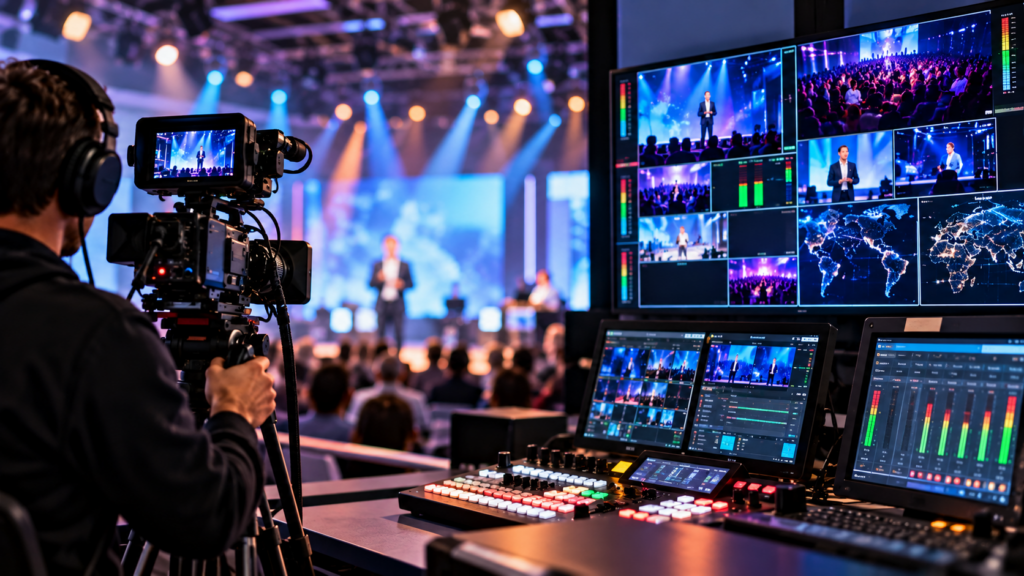
Direct-to-Home satellite broadcasting, or DTH, uses satellites to distribute television services directly to receiving equipment at viewers’ premises. A DTH broadcasting system can include a head-end, encoders, multiplexers, conditional access systems, RF equipment, high-power amplifiers, an uplink antenna and monitoring systems.
Satellite broadcasting can be particularly useful where a service needs to cover large geographic territories or where terrestrial infrastructure would require a substantial number of transmission sites. The broadcaster sends the prepared service through an uplink to a satellite, which retransmits the signal over its coverage footprint. Viewers receive the service through satellite dishes and compatible receivers.
AUCOM’s DTH satellite solutions include DVB-S and DVB-S2 head-end integration, multiplexing, transport stream configuration, conditional access, RF uplink and monitoring. Successful satellite broadcasting requires the head-end, RF chain, satellite capacity and receiving environment to be engineered as one system.
IPTV and OTT Extend Broadcasting to IP Networks
Internet Protocol has created additional ways to distribute professional media services. IPTV generally delivers television through a managed IP network, while OTT services distribute media over internet connectivity to compatible applications, browsers, smart televisions and other connected devices.
These platforms differ technically from traditional one-to-many terrestrial and satellite broadcasting, but they increasingly form part of the same media strategy. A broadcaster may originate a television channel once and then prepare versions of that service for DTT, satellite and IP delivery.
IP-based delivery introduces additional considerations such as network capacity, adaptive bitrate encoding, content delivery, device compatibility, platform security and user management. DVB specifications also address audiovisual coding for both broadcast and broadband applications, demonstrating how traditional broadcasting and IP-based delivery increasingly operate within a connected technical environment.
DTT, DTH, IPTV and OTT Serve Different Broadcasting Requirements
There is no single broadcasting platform that is appropriate for every organisation or audience. The choice depends on the required coverage, available infrastructure, audience devices, service model and operational objectives. Some broadcasters use one primary platform, while others combine several technologies to increase reach.
| Platform | Delivery Method | Typical Reception | Key Planning Consideration |
|---|---|---|---|
| DTT | Terrestrial RF transmission | Antenna and compatible television or receiver | Coverage planning, spectrum and transmitter network design |
| DTH | Satellite transmission | Satellite dish and receiver | Satellite capacity, link budget, uplink and footprint |
| IPTV | Managed IP network | Set-top box, television or supported application | Managed network capacity and service quality |
| OTT | Internet-based delivery | Smart TV, mobile device, browser or streaming device | Connectivity, scalability, content delivery and device support |
Broadcast Playout Controls What Goes to Air
Playout is a critical stage in professional television broadcasting because it converts prepared media into a continuous channel output. The playout environment controls programme schedules, advertising, graphics, channel branding and other elements that need to appear at defined times.
Modern playout systems can also integrate with media asset management, automation, ingest, monitoring and multiple delivery outputs. A single operation may need to originate several channels while providing different regional feeds or delivering services to both conventional broadcasting infrastructure and online platforms.
For a deeper explanation of this part of the chain, see AUCOM’s guide to broadcast playout for professional media delivery.
The Broadcast Head-End Prepares Services for Distribution
A head-end acts as a central processing point in many broadcasting systems. It can receive channels from playout or external sources, encode video and audio, combine services through multiplexing, insert service information, implement conditional access and create outputs suitable for the selected distribution platform.
The exact head-end architecture depends on the broadcasting platform. A DTT head-end prepares services for terrestrial transmission, while a DTH head-end prepares them for satellite uplink. An integrated environment may also provide outputs for IP-based platforms.
Redundancy and monitoring are particularly important at this stage because a head-end fault can affect multiple channels or downstream transmission sites. Backup processing paths, alarm management and appropriate monitoring points can therefore form part of the system design.
Encoding and Multiplexing Make Digital Broadcasting Practical
Uncompressed professional video requires substantial data capacity. Encoding uses compression technology to reduce the amount of data required while maintaining a suitable level of video and audio quality. The selected codec, bitrate, resolution and other settings affect both picture quality and the amount of transmission capacity required.
Multiplexing allows multiple programme services and associated data to be organised for distribution through a common transport system. This is one of the important differences between older analogue television systems and modern digital broadcasting architectures.
The DVB specification for video and audio coding in broadcast and broadband applications covers audiovisual coding across terrestrial, satellite, cable and IP-based delivery environments. Standards-based design is important because different components throughout the broadcasting chain need to exchange content reliably.
System Integration Connects the Broadcasting Environment
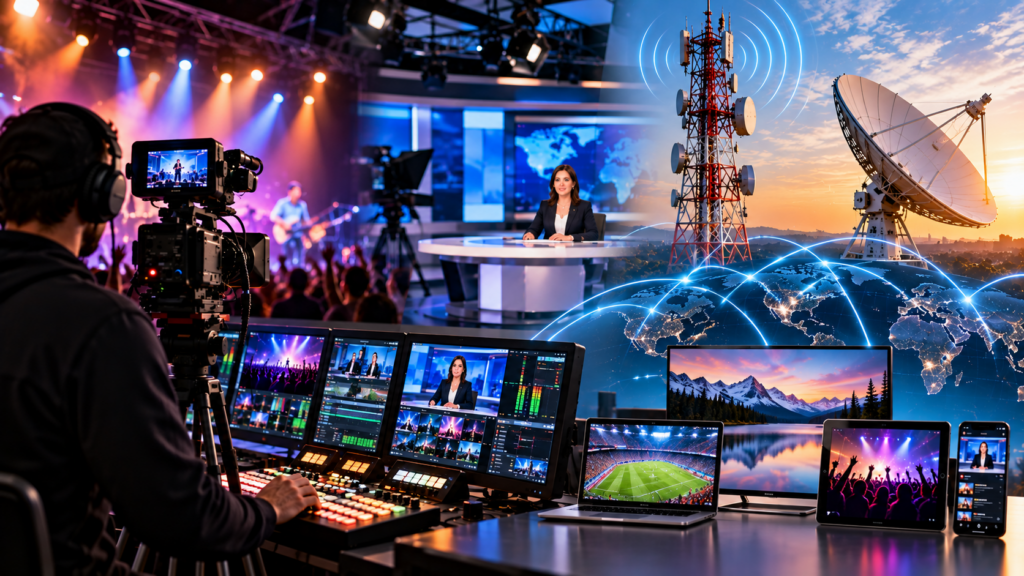
A professional broadcasting system rarely consists of equipment from only one manufacturer. Production systems, playout platforms, encoders, multiplexers, routers, network switches, transmitters, satellite equipment, storage, monitoring tools and power systems may all come from different suppliers.
System integration ensures these technologies operate as a complete environment rather than as isolated components. Interfaces, signal formats, timing, networking, monitoring, failover behaviour and control systems all need to be considered during the design and commissioning process.
AUCOM’s system integration and testing services include multi-vendor system integration, network and infrastructure integration, broadcast and head-end infrastructure, system testing, performance testing and final commissioning. Testing can verify that the completed broadcasting system performs correctly before it enters operational service.
Monitoring Helps Keep Broadcasting Services Available
Broadcasting is an operational service, so deploying the infrastructure is only the beginning. Technical teams need visibility over the system after launch. Monitoring can cover incoming sources, playout outputs, encoders, multiplexes, network links, transmitters, satellite systems, power equipment and the signal actually received off air.
Centralised network management can be particularly valuable where broadcasting infrastructure is distributed across multiple transmission sites. Instead of waiting for viewers or regional staff to report a service failure, engineers can receive alarms when monitored parameters move outside defined operating conditions.
Monitoring should also form part of redundancy planning. A backup link or standby system provides limited protection if operators cannot identify that it has already failed before the primary path develops a fault.
Broadcasting in Africa Requires Practical Network Planning
African broadcasting networks can operate across very different geographic and infrastructure environments. Large cities may have strong telecommunications connectivity and established transmission infrastructure, while rural or remote areas may present challenges involving electrical supply, site access, backhaul connectivity and maintenance resources.
These differences influence broadcasting architecture. Terrestrial television may require carefully positioned transmitter sites and gap fillers to achieve the intended coverage. Satellite broadcasting can provide wide-area reach without constructing terrestrial transmission sites throughout the entire service territory. IP-based platforms depend on suitable connectivity at both the distribution and audience sides of the service.
For this reason, broadcast technology should be selected according to actual service requirements rather than simply choosing the newest available platform. Coverage targets, audience access, existing infrastructure, spectrum, connectivity, resilience, operating skills and long-term maintenance all need to be considered.
What Should Organisations Consider When Planning a Broadcasting System?
Planning should begin with the required service rather than individual equipment. Organisations need to establish who the intended audience is, where that audience is located, which services will be offered and how viewers are expected to receive them. The technical architecture can then be developed around those requirements.
Important questions include the number of television or media services required, the desired picture and audio quality, coverage objectives, expected availability, redundancy requirements, monitoring model, existing infrastructure and potential future expansion. Organisations should also consider how the broadcasting system will be maintained after commissioning and whether local technical teams require training and documentation.
The ITU Handbook on Digital Terrestrial Television Broadcasting Networks and Systems Implementation provides further technical guidance on digital television networks, systems, audiovisual quality, transmission and implementation.
Modern Broadcasting Is Becoming a Multi-Platform Environment
The distinction between traditional broadcasting and broadband media delivery is becoming less rigid. Television organisations can now operate linear broadcast channels alongside streaming services, catch-up television, connected applications and other digital services. Content can originate from the same production environment while being processed differently for each destination.
This convergence does not eliminate traditional broadcast technology. Terrestrial and satellite networks continue to provide efficient ways of distributing linear television across large audiences, while IP technologies provide additional flexibility for connected devices, on-demand services and personalised delivery.
The appropriate strategy may therefore combine technologies rather than replacing one with another. DTT can provide terrestrial coverage, DTH can extend satellite reach, and IPTV or OTT can provide additional IP-based access. The key technical requirement is ensuring that the complete environment is integrated, monitored and supportable.
Building Reliable Broadcasting Infrastructure
Modern broadcasting is an interconnected process covering content creation, playout, encoding, multiplexing, distribution, transmission, reception and monitoring. DTT, DTH, IPTV and OTT provide different routes to the audience, and each requires appropriate infrastructure, engineering and operational planning.
For broadcasters, governments, telecoms providers and media organisations across Africa, successful broadcast technology should match the real coverage and service objectives of the organisation. Equipment selection is only one part of that process. Network architecture, interoperability, redundancy, monitoring, testing, maintenance and technical support all influence how reliably the broadcasting service performs over its operational life.
AUCOM provides broadcast and telecommunications solutions across terrestrial television, satellite distribution, production and playout, system integration, testing and long-term technical support. An integrated approach allows the different stages of the broadcasting chain to be planned around the required audience, delivery platform and operational environment rather than treating each component as a separate project.
Frequently Asked Questions About Broadcasting
What is broadcasting?
Broadcasting is the distribution of television, radio or other media content to an audience through technologies such as terrestrial transmission, satellite networks and digital delivery platforms. A modern broadcasting system can include production, playout, encoding, multiplexing, distribution, transmission and monitoring infrastructure.
What is digital broadcasting?
Digital broadcasting uses digitally encoded video, audio and data instead of traditional analogue signals. Digital systems can use compression, multiplexing and other technologies to distribute multiple services efficiently through terrestrial, satellite or other digital networks.
What is the difference between DTT and DTH broadcasting?
DTT uses terrestrial transmitters to deliver digital television to receiving antennas within defined coverage areas. DTH uses satellites to transmit television services directly to satellite dishes and receivers. The appropriate platform depends on factors including geographic coverage, infrastructure, spectrum and service requirements.
What equipment is used in television broadcasting?
Television broadcasting can use production equipment, playout servers, automation systems, encoders, multiplexers, routers, network infrastructure, terrestrial transmitters, satellite uplink equipment, antennas, monitoring systems and power infrastructure. The exact equipment depends on the delivery platform and network architecture.
What is a broadcast head-end?
A broadcast head-end is a central processing environment that prepares television or media services for distribution. It can include encoding, multiplexing, service information, conditional access, monitoring and output systems configured for terrestrial, satellite or other delivery platforms.
Can broadcasters use DTT, satellite and OTT together?
Yes. A multi-platform broadcasting strategy can distribute content through DTT, DTH satellite and IP-based services such as OTT or IPTV. Each output requires appropriate processing and delivery infrastructure, but the services can form part of an integrated broadcasting environment.